For People Who Keep Saving the Reel and Never Doing It
You ask. You look. You write it down. Forty-five times, in that order — until you're holding something a mood can't fake and a memory can't rewrite.

You've tried some version of this before. This isn't a page explaining what an affirmation is. This is where each one stopped working.
records a feeling, and a feeling can't be checked a month later. By day ten you're grading your own mood and calling it a practice.
stays quiet enough for you to argue with it. You win that argument every time.
gave you forty modules and a login you stopped using. You can recite the theory back word for word. You still can't point to a single page that proves any of it happened.
The folder fills up. The notebook stays empty.
None of them left you holding anything at the end. That's the only gap this closes, and it's a narrow one.
Three steps. Ten minutes a day, and not ten minutes in a row.
One sentence, out loud, once. Out loud, because a sentence you can hear is harder to talk over than a sentence you only think. Not ten times. Not until it feels true. Once, and then go to work.
One concrete thing to watch for that day. Not a feeling — a person, a message, an amount, a door. Something a stranger standing next to you could have seen too.
One line at night. What you asked. What you noticed. Factual, the way you write down a phone number.
Do that forty-five times and you're holding a stack of them, and a stack can be checked. A mood can't. That's the entire reason the order runs the way it runs.
"I started asking for something, and I started finding things. In that order."
I'm not telling you the asking caused the finding. I don't know that. I'm also not going to tell you it's nothing but attention, because I don't know that either, and I'm not going to pretend in either direction. The order of the facts is the part I can put my name on. So the order is the part I teach.
Five tracks of nine days. You run them in order.

Amounts that already crossed your day — the ones you'd have missed if you hadn't written them down.

The ask about taking up room where you already are, and the things you can count on your own, without needing anyone to react.

The sentences that arrive about you shaped like facts. You write them down with the hour and the room, as material. You don't argue with them and you don't explain them away.

What you were last paid, what you'd say out loud now, and what happens in the silence after you say it.

Things that reached you without you paying for them, counted and dated. Backwards, on purpose.
Day 45 has no ask. You sit down with the notebook and read it from page one, in one sitting. You're looking for two things: the entries you'd already forgotten, and the ones that repeat. Then you close it. You don't score it, and the guide doesn't tell you what it proves.
This is Day 1, copied exactly as it appears in the PDF. Nothing here is a preview of something better kept back for later — every one of the 45 days looks like this.

58 pages · yours the minute you pay
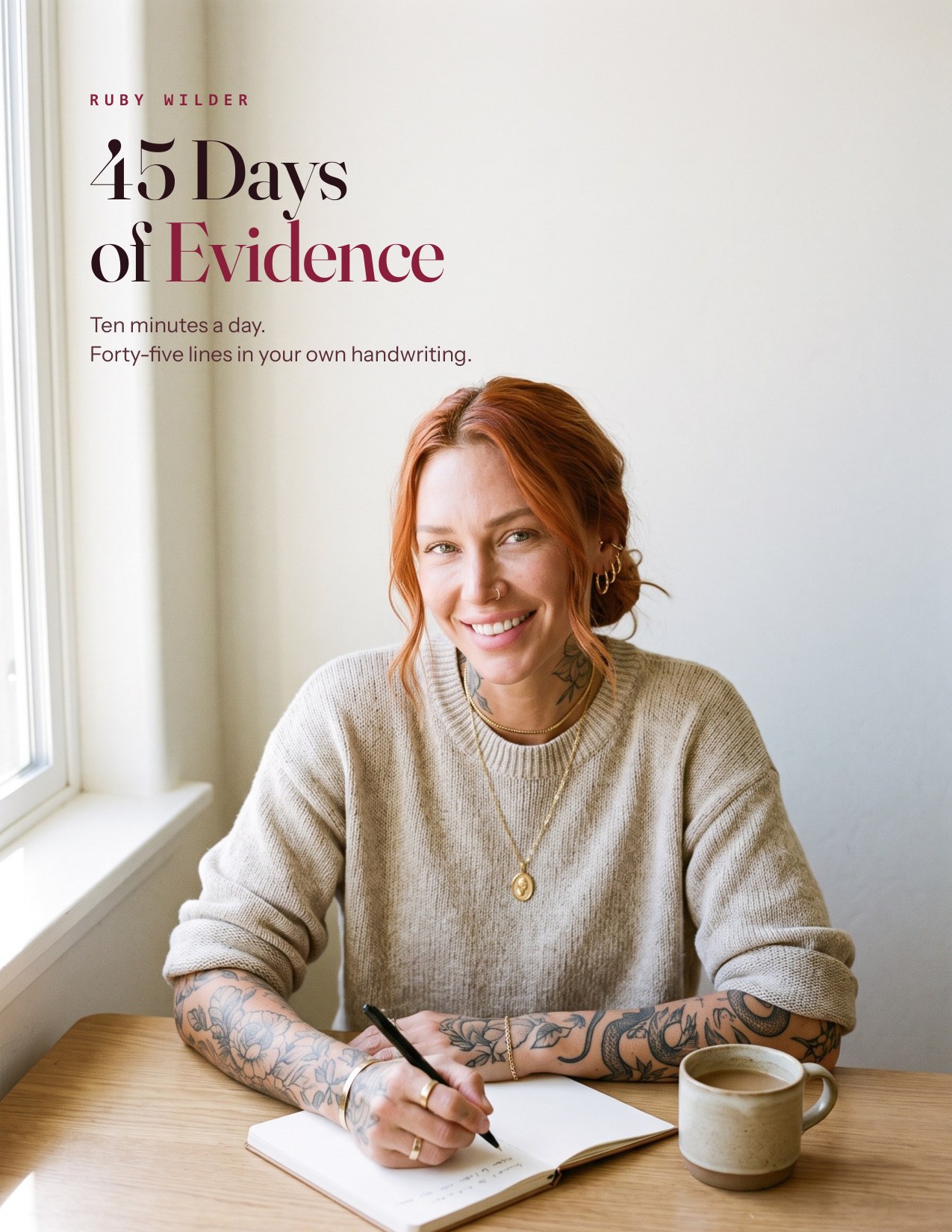
Ruby Wilder writes at wilderbrain.com about money, rooms, and the sentences that show up uninvited at night. She is not a therapist, a financial advisor, or a coach, and this guide says so on its first page.
She lives near Chicago and owns more notebooks than she will admit to. She's also the author of The Date I Owed Myself.
That's the sentence this was built around. The reason you can't tell is that nothing was written down at the time, so the only evidence is your memory, and your memory is grading itself. Forty-five dated lines are a document. On day 45 you read it in one sitting and mark what repeats. What that means is yours — I'm not going to tell you in advance what you'll find there, because I don't know.
That's real, and it doesn't go away on a schedule. Out loud isn't decoration, it's the mechanism — a sentence you can hear is harder to argue with than one you only think. Say it once, quietly if you have to, and go to work.
Assumed, and planned for. Miss a day and you do that day next: no doubling up, no starting over. The number on the page is the day of the work, not the date on the calendar. A notebook with a gap in it is still a notebook. What ends this is deciding the gap ruined it.
There's nothing here to save. The day is picked for you, the sentence is written for you, and the thing to look for is written for you. The whole decision left in the morning is whether to say one sentence out loud.
No, and the guide doesn't ask you to at any point. The only claim I make is the order of the facts. What's on the other side of that order, I don't know, and I'm not going to arbitrate it for you at $19.
A PDF you can read on your phone, tablet, computer, or e-reader, or print at home.
One PDF, 58 pages, delivered right after checkout. No login, no drip, no week-by-week release. Everything arrives at once, and it's yours to keep and to print.
No. The two work on their own.
If it's not for you, say so. The checkout page has the details on getting your money back — I'm not going to make that complicated.
Everything after that is a line a night.
Forty-five days from now you either have a notebook full of your own handwriting, or you don't. That's the whole promise, and it's the only one that doesn't depend on anything outside of you.
One rating, a line or two if you've got it. Your email stays with me — it never shows on the page.
Be the first to leave a review.
More from Ruby

Seven pages for the ninety seconds before you hit send.

Twelve dates, one yellow notebook.

Twelve ninety-second tapes for the minute before you text him.